
Your kilowatt-hours were flat this month. Same shifts, same production, same equipment. But the electric bill came in higher this month.
Here’s what you might be missing: your electric bill isn’t based on energy use alone.
Many commercial and industrial rates also charge for demand. That’s the most power your facility draws in a short window, usually 15 or 30 minutes. Your single highest window of the month can set the demand charge for the whole bill, even if it happened on just one day.
For many manufacturers, it’s one of the largest line items on the bill.
In Part 1, we covered rate schedules and how they determine the charges applied to your electricity usage. In Part 2, we’re looking at the charge that most often surprises our clients: demand.
kW vs. kWh: Two Different Things You’re Paying For
- Energy (kWh) is how much electricity you used over the whole billing period. Think of it as the miles on your odometer.
- Demand (kW) is your highest average power draw over a short interval during the billing period, usually 15 or 30 minutes. Think of it as your fastest sustained stretch on the highway, not your average speed for the trip.
Utilities use demand charges to recover costs associated with providing and maintaining the electrical capacity needed to serve customers, whether that demand occurs every day or only during occasional peaks.
Here’s a simple example. Two plants each use 100,000 kWh in a month. One runs steady around the clock. The other starts every compressor, oven, and motor at 7:00 a.m. on Monday. Same energy, but the second plant’s peak, and its demand charge, can be far higher.
What it looks like on your bill: look for a line labeled “Demand,” “Billing Demand,” “kW,” or “Maximum Demand,” usually with a per-kW price. Some rate schedules split it further into on-peak and off-peak demand, each priced differently.
Example Bill 1:
Meter Read Box:

Line-Item Billing Charges:

This facility recorded a maximum demand of 1,110 kW, with an on-peak demand of 1,069.2 kW. Although its off-peak demand also reached 1,110 kW, the utility’s rate structure bills only the 41 kW difference as additional off-peak demand.
This is why understanding your rate schedule matters. The highest measured demand doesn’t always translate directly into the demand quantity charged on each line of your bill.
And sometimes, the demand used to calculate your current charges isn’t even from your current billing period.
Ratchet Clauses: When Last Summer Is Still on This Month’s Bill
This is the one that catches people off guard.
Many commercial and industrial rate schedules include provisions that use historical demand to calculate current charges. One common example is a demand ratchet, which establishes a minimum billing demand based on a percentage of a previous peak.
So, if your plant hit a record peak during a hot week last July, you could still be paying for a share of that peak in January. That’s true even if your actual demand this month was much lower.
Ratchets aren’t errors. They’re written into the rate schedules. But they can create unexpected costs, particularly when facilities experience significant changes in their operations:
- A one-time event, like a startup after a shutdown or equipment testing, sets a peak you pay for all year.
- Your operations have changed (a line was shut down, equipment was replaced), but the ratchet keeps billing you for the old load.
- The ratchet is applied incorrectly, using the wrong peak month or the wrong percentage.
What it looks like on your bill: compare “Actual Demand” or “Metered Demand” to “Billing Demand.” If billing demand is higher than what you actually used, a ratchet or minimum is likely at work. The question is whether it’s being applied correctly, and whether it still makes sense for your facility.
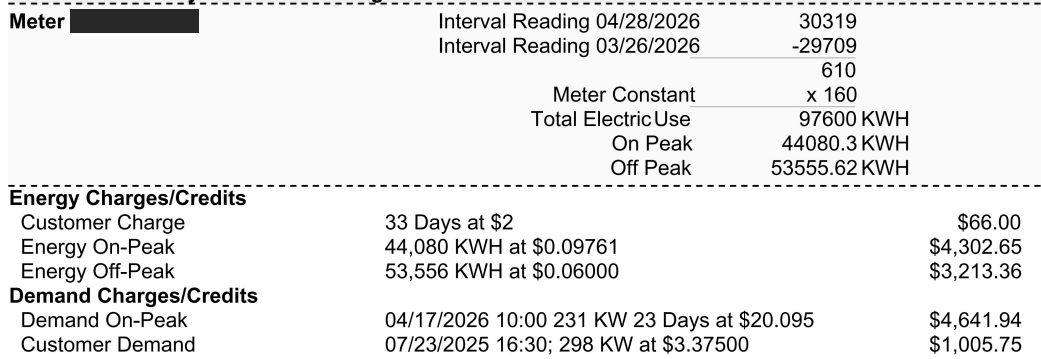
Example Bill 2: Historical Demand Affecting Current Charges
This April 2026 electric bill includes a customer demand charge based on a peak recorded in July 2025. While the facility’s current on-peak demand was 231 kW, the utility continued to use the historical 298 kW measurement for a separate demand charge. This illustrates how a previous peak can affect utility costs months after it occurs, depending on the applicable rate schedule.
What to Question on Your Own Bill
Pull your last 12 months of bills and ask these questions:
- Is my billing demand different from my measured demand? If so, why? Demand ratchets, minimums, and other rate schedule provisions can affect the quantity used for billing.
- When did my highest peak happen, and what caused it? If it came from a one-time event, you may be paying for it all year.
- Has my operation changed since that peak? Equipment removed, a line shut down or shifts reduced can all mean the ratchet no longer reflects how you run.
- Is the meter multiplier correct? Demand readings are multiplied before they’re billed. A wrong multiplier inflates every demand charge. (We covered this in Understanding Meter Multipliers in Electric Meters.)
- Does my rate schedule still fit my demand profile? Some rates are built for high, steady loads and others for lower or more variable ones. That’s where this ties back to Part 1.
If you can’t answer these from your bills, you’re not alone. Demand charges can be difficult to interpret, especially when multiple billing components, historical peaks, and complex rate schedules are involved.
Up Next in Part 3
The rate schedule sets the price. Demand sets the peak. But if your facility runs a lot of motors, compressors or pumps, there may be one more charge hiding in your demand: power factor. In Part 3, we’ll explain it with the help of a horse and a train car, and show what it could be costing you.
Not Sure If Your Rate Is Right?
Upload your bill and get started to learn how a proactive utility review could help- no phone call required.
SM Engineering has been helping manufacturers reduce utility costs since 1982 without changing how they operate.