
Picture this: your operations haven’t changed, your headcount is the same, production is steady; but your electric bill just went up again. You assume it’s a rate increase and move on.
Here’s the uncomfortable truth: your utility company isn’t going to call you to say you’re overpaying. They’re not required to. And in most cases, they have no incentive to. So, the errors sit there, month after month, buried in line items nobody’s looking at while the total keeps climbing.
This is a four-part guide to what’s actually on your electric bill and what to question. We’re starting with the line item that most manufacturers have never once looked up: the rate schedule. It’s easy to overlook and it’s also the line that sets the price for everything else.
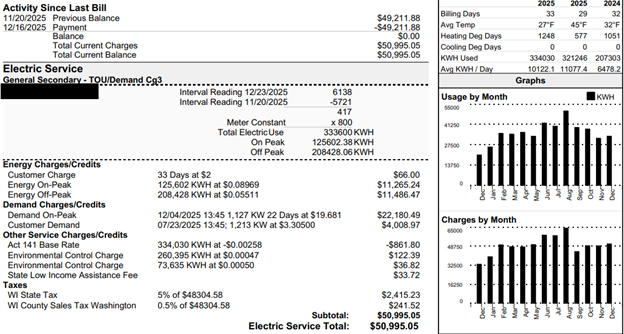
A real industrial electric bill (Wisconsin, redacted) — $50,995.05 for a single month. The rate schedule is the very first line under “Electric Service.” Everything else on this bill flows from it.
The Anatomy of Your Rate Schedule
A rate schedule, sometimes called a rate class or tariff, is the pricing structure your utility uses to build your bill. It determines your per-unit energy rates, how your demand charges are structured, which riders apply to your account, and how all of it is calculated together. Think of it as the rulebook. Change the rulebook, and every number on the page changes with it.
Different rate schedules exist for different types of customers: small commercial, large commercial, industrial, time-of-use, interruptible service, and more. A food processor running 24/7 has very different needs than a machine shop running one shift. A manufacturer with heavy, consistent loads may be far better served by a flat industrial rate than a time-of-use structure, or vice versa. There’s no one-size-fits-all answer, which is exactly why the assigned rate deserves scrutiny.
How to Spot It on Your Bill
Your rate schedule appears near the top of your bill, usually listed under the service description. It may look like a code, a name, or a combination of both, but it’s there on every bill, every month.
How to Know If Yours Still Fits
Here’s where it gets worth questioning: utilities don’t proactively move you to a better-fitting rate.
They assign one when you open the account and it tends to stay there whether it still is the most
economical for your operations or not.
What’s changed at your facility since the account was opened? New equipment? Different
production hours? A change in ownership? Each of these can shift which rate structure is most
favorable. However, none of them trigger an automatic review from your utility.
These rates would have gone uncontested as we didn’t have the expertise to check ourselves.
Up Next in Part 2
The rate schedule is the foundation but it’s also just the beginning. There’s a lot more on your bill worth questioning and we’re just getting started.
Not Sure If Your Rate Is Right?
Upload your bill and get started to learn how a proactive utility review could help- no phone call required.
SM Engineering has been helping manufacturers reduce utility costs since 1982 without changing how they operate.